
Grid and Flex canvas
Designed as part of one consistent workflow, including useful loading, empty, validation, and error states.
Developer Tool
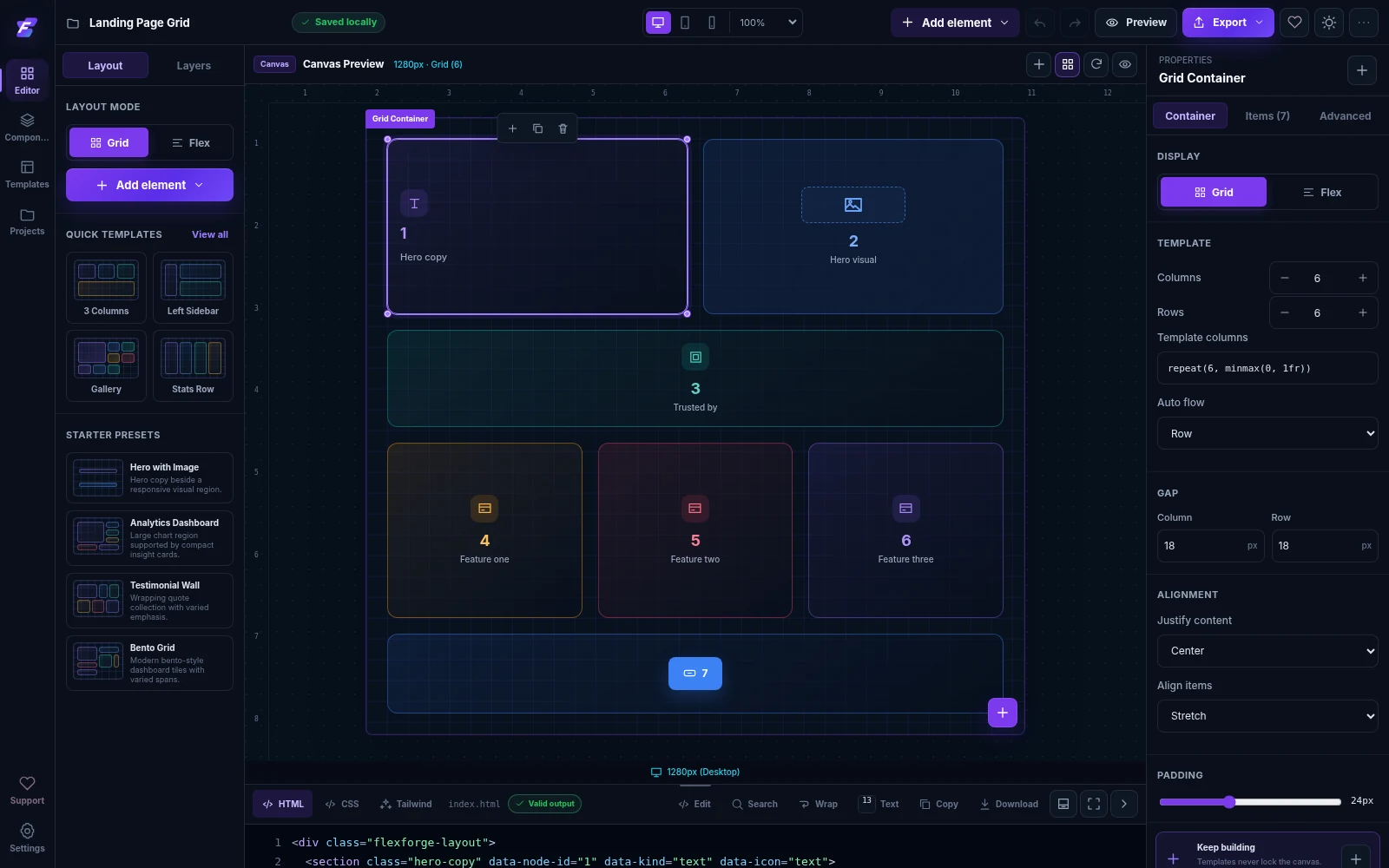
FlexForge turns responsive layout composition into a visual workflow while keeping the generated HTML, CSS, Tailwind, React, and Vue output visible and portable.
Problem
Visual layout tools often hide the underlying code, require accounts or cloud services, or become difficult to use once a layout grows beyond a simple demo.
Product direction
A local-first editor with one shared document model for canvas rendering, live previews, generated code, saved projects, templates, validation, and portable ZIP exports.
Capabilities
Designed as part of one consistent workflow, including useful loading, empty, validation, and error states.
Designed as part of one consistent workflow, including useful loading, empty, validation, and error states.
Designed as part of one consistent workflow, including useful loading, empty, validation, and error states.
Designed as part of one consistent workflow, including useful loading, empty, validation, and error states.
Designed as part of one consistent workflow, including useful loading, empty, validation, and error states.
Designed as part of one consistent workflow, including useful loading, empty, validation, and error states.
Product views
Outcome
A curated suite of practical browser utilities with a consistent interface and privacy-conscious defaults.
View case study